Showing posts with label football. Show all posts

Friday, 22 October 2010

NW Business Interests Unite To Save Key Turkish Airlines Advertising Strategy


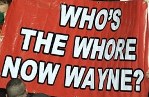
But he'll still go I think, 'cos he's had his feet held to the fire. I mean look at this picture from Weds game and note the correct use of the apostrophe. That's not the Stretford End we all know and love, is it? That somehow has a ....well, slightly more corporate feel don'tcha think? I think his rather low rent agent got stuffed by the PR machine of a large organisation who had fought the world class Spice Girls/Beckham PR machine to a high scoring draw some years before. That's gotta hurt and is no basis for a long term relationship.

Plus, of course, both the dressing room and the fans now detest him and no amount of goals are ever going to restore those relationships entirely.

But he's more likely to go in the summer than January. In either event, the club is going to make a fortune when he does go and he's passed up the chance to ever be the front man for a insurance company TV ad trying to project a subliminal message of reliability.

Addendum: final comment, via that weekly footie photoshop competition at the Guardian

Tuesday, 13 July 2010

Nationalism and Globalisation: Two Snapshots in Time

Mason's blagged his way into a party:

Another obvious social and political fact resonating off last night's events is how Spain has modernised socially. I watched the match in a bar full of Catalan people, some of whom had been on the million strong demo in favour of independence from Spain the day before, carrying banners saying "Adeu Espana". As they surged onto the street last night they were all for Spain, and they were met by the entire staff of a Pakistani-owned pizza shop called Al Capone's, who surrounded me shouting (in English): "We are Spanish, we are Spanish. We Love Spain!". On the streets where the Catalan flag and language were once repressed, people used both to celebrate the Spanish victory. In a landscape shaped by inquisition-era Catholicism, gay men leapt around in the fountains wearing only bathing trunks bearing the word "Espana".

Basically, as in the Facebook profile option, "it's complicated" - and there is no going back.
But, ah, it ain't so complicated everywhere. Or at least not complicated in the sense of seeing new juxtapositions of attitudes and identities emerging, which manage to be both dichotomies and overlaps. Hyper-modernity carries with it a trailing gown of history's unfinished business in some places.


So we have football fans acting out their (temporary) role as joyful nationalists in one place, and the representatives of two* national traditions acting out their role as anything but joyful football fans in another.

(*No, I've not signed up to the BICO line. But you have to admit that in Northern Ireland it's taking a while for 'all that is solid to melt into air' as Marx put it, and a grudge, held long enough, looks powerfully like a nationalism to me....)

Monday, 28 June 2010

The English Disease


Despite the fact I owe several people a reply (yes, I mean you Boffy), I can't help but be distracted by the lefty blogosphere's attempt to shoehorn the cautionary tale of the Great South African Football disaster into any available political narrative they'd care to spin.

Exhibit A is provided by Cde Mason from Newsnight:
"Maybe in this World Cup we've seen the first real triumph of the economics of modern football over skill and organisation: the triumph of a club-first, nation-last mentality and individualism over teamwork.....

England's outstanding badness in World Cup 2010 must be a symptom of something bigger: the fact that we've got the most expensive, highest leveraged club system - and that none of our players play outside it - must have contributed to the weakening of commitment to the national colours, the evisceration of upcoming talent, the creation of an unmanageable team of frightened individuals...

Like failed bankers they will pay no penalty for failure other than public opprobrium and, as everybody in high finance knows, you can live with that as long as you own a Lamborghini.

Basically, we've just seen the Lehman Brothers of football and it was not pretty."
Exhibit B is provided by the ever prolific Chris Dillow:
"I blame Taylor. Not Graham Taylor, but Frederick Winslow Taylor.

He invented scientific management. The effect of this was to break down traditional craft work - where manual and physical labour combined - and give us workplaces in which management did the thinking and labourers did the grunt work. This created an iron curtain between intelligence and physical labour not just in the workplace, but in our culture.

The problem is, though, that football needs both brains and physical work.
It’s no accident that the European nation in which craft traditions declined most sharply is also the team that is weakest in those areas where intelligence is most needed.

I mean this is in two senses. First, we are tactically inflexible; Fabio Capello has been criticised for sticking rigidly with 4-4-2, but could this be because he didn’t trust his players to change things?

Secondly, we are under-supplied in positions where intelligence is needed: ... the players capable of changing the tempo of the match; and the ones who can find space and pick out a pass - England has no-one who even vaguely resembles Cesc Fabregas or Mesut Ozil."
So Paul's saying the problem is that English football is a bit too like how the City operates - and that's bad for the country, even if it's good for the big clubs/city firms - and Chris is saying, no, it goes deeper than that: it's the very idea of 'modern' management which is at the root of the problem. But I can't get the faint image of men with hammers defining the problem as a nail out of my mind when I read these thoughts. Because, after all, England has had several people at least as good as Fabregas or Ozil over the years - most especially this pocket genius . It really ain't skill that's the problem - and Capello is clearly a proven manager.

Exhibit C, however, from Jamie K gets closer to the nub of it I think:

"The whole In-ger-lund setup, with all its orchestrated hysteria and commercial hoo-haa is a kind of consolation prize from the EPL to the FA after it seized control over the game: OK, we’ll lend you some of our assets, go whoop up the punters with a load of flag wagging and make a bundle for a few weeks.

..... The EPL is a globalised institution and its major players live within its boundaries. True, they spend more of their actual time in the tax boundary known as the UK, but I bet the life of your average England player has a lot of the same weird affectlessness of life in a gated compound for foreigners in Shanghai, only with added celebrity status to cope with and profit from. ....

So the World Cup is an occasion that brings about a particularly sharp collision between globalisation and national sentiment, both financially driven. ... I think it ... has significant downstream consequences (such as: how do you make a team from an assemblage of players who work in various supporting roles in multinational teams, often with players better than they are). At any rate, it’s a weird atmosphere in which to try and play football."

But this is still not quite right - because, with the exception of the Germans perhaps, this is a condition which affects all modern footballers and all national teams. I think the problem is not with the globalisation per se, but with the particular national sentiment it is in tension with. England is a nation without a state, but one used to assuming that the trappings of a former grand imperial state - Britain - naturally fit it. Hence the chorus of 'Rule Britannia' from the crowd, not 'Jerusalem'. But those old imperial clothes don't fit Britain any more, much less England. So we get this weird and utterly self destructive hysterical neurosis at every big sporting tournament England qualifies for and it affects not just the media and the fans but the team as well.

So my recipe for an England victory at the next World Cup? Let Alex Salmond win his referendum on independence. Cut England down to size in reality, and perhaps the psychic expectation that they deserve to rule the world will die away.

Oh: and pray for a new Paul Scholes to emerge. He scores goals y'know.

Saturday, 21 February 2009

Jumpers for Goalposts: On Football and Banks

I've been thinking about how bloody dreadful going to the football was when I was young: the leery crowds, the lack of adequate safety measures, the simmering mood of aberrant masculinity, the pig pens of stadia. I did go, nonetheless, and got various kinds of joy from it, not all of which I care to confess to at this distance in time.

It was seen as a game irredeemable tainted with hooliganism, racism and misogyny; a sport played in dangerous, antediluvian premises. All too often, it really was like that. As Heysel, Hillsborough and the Bradford fire revealed.

This was well before the days of When Saturday Comes and the Mark Perryman Liberation Front (aka Philosophy Football) you understand. Football was not cool. It was seen as the sporting analogy of those old nineteenth century smokestack industries Mrs. Thatcher was busy closing down - a survival of a less attractive, class bound past. The future, surely, was individualised, participative sporting activity (going to the gym, jogging and so on) involving choice, not attendance at ritualised mass events? Especially not mass events so overwhelmingly dominated by men, and often uncouth young white men at that.

It didn't turn out like that did it? Sure, a lot more people go to the gym than they did in the 1980s (although I seem to see fewer joggers these days). But football is still a mass spectator sport of choice - indeed, the mass sport. It's just that its now advertised on the telly with multi-racial families moving sofas to the edge of a pitch and running onto to comfort 'dad' when he gets tackled. A sanitised - and to a degree, de-misogynised - version of the old 'mass' entertainment has been sold back to us as 'niche' entertainment. How did this happen?

First, Mrs.Thatcher cleared the ground with her imposition of all-seater stadia and other safety measures. Secondly, Europe, in the form of the UEFA ban on English clubs after Heysel, economically forced a degree of painful change as well. Thirdly, and probably most important, was football's discovery that it could form a symbiotic relationship with an emerging and socially disruptive new technology, satellite TV. TV made English football rich. Football, with movies (another survival of mass entertainment from the pre-WW2 years), acted as the cutting edge which allowed 'niche' satellite TV to disrupt the old oligarchical, 'top-down' system of public broadcasting. So football made Murdoch and co very rich as well.

Now my hunch is that all this may have already peaked. English football is deeply indebted, and even Abramovich is facing something of a financial pinch. But that's not my major concern at the moment. What I want to tease out is the potential for a metaphor.

The global crisis means something is going to have to change in our national economic structure. The government needs to sweep away the dangerous aspects of our banking system just as Thatcher swept away those old death-trap stadia. This has to mean, at the very least, a return to 'pre-big Bang' division between retail and merchant banking and quite possibly a version of Richard Murphy's 'network banking' idea. International co-ordination is necessary to enforce a cultural change in world finance, just as the UEFA ban after Heysel was intended to do in English football. & the remains of our manufacturing base needs to be energised to engage with emerging technologies, especially green technologies, to provide a way forward in terms of employment and sustainable wealth creation.